
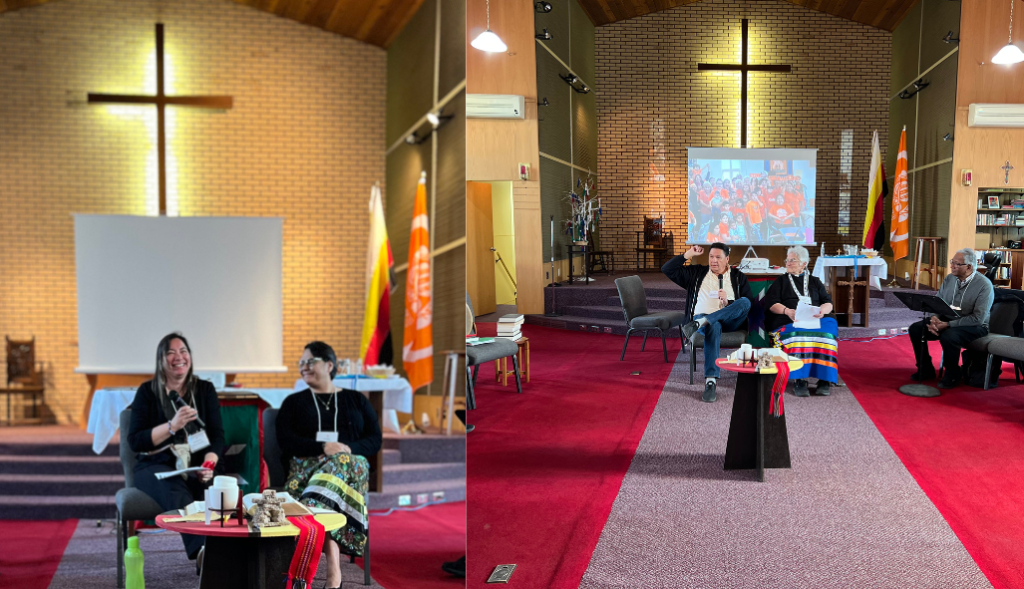
WINNIPEG, MB — On May 21, 2026, the Governing Board of The Canadian Council of Churches (CCC) gathered in Winnipeg for a special day of reflection and relationship-building on the theme of “Where Now for Truth and Reconciliation for Churches in Canada?” The aim was to explore how the CCC and its member churches continue to honour and live into the commitments made in their 2014 Expression of Reconciliation presented at the final National Event of the Truth and Reconciliation Commission (Edmonton, AB).
In the morning, Governing Board members engaged in a panel conversation with local Indigenous Christian ministry leaders to reflect on the Holy Spirit’s role in their ongoing work. Hosted by Rev. Vince Solomon (Epiphany Indigenous Anglican Church), the morning opened with a welcome song by Rev. Solomon, a land acknowledgment, and a reading from John 20:19-22, anchored by the verse: “He breathed on them and said to them, ‘Receive the Holy Spirit.’” The panel featured prominent voices including Rev. Vince Solomon, Shannon Perez (Executive Director, Indigenous Family Centre), Lisa Raven (Executive Director, Returning to Spirit, Inc.), and Rev. Dr. Margaret Mullin (Place of Hope Indigenous Presbyterian Church). Indigenous leaders shared deeply personal stories of how the Spirit guides their local ministries and reflected on the gifts and challenges of walking both traditional Indigenous and Christian spiritual paths in a wholistic way. As Rev. Solomon memorably put it, “Jesus is good medicine.” They also emphasized the need for fully Indigenous-led ministries, churches, and ecumenical initiatives across Turtle Island.
In the afternoon, Governing Board members visited the National Centre for Truth and Reconciliation (NCTR) and received a presentation from Kaila Johnston, NCTR Director of Education, Outreach, and Public Programming, and Noé Prefontaine, NCTR Education Coordinator. Governing Board members also engaged in critical dialogue about the CCC’s current and future journey of reconciliation, sharing the initiatives that have already been undertaken by CCC member churches and envisioning the steps that could be taken together in the future. Participants emphasized that truth and reconciliation is an ongoing process – a meaningful journey rather than a fixed destination – which resonated with Lisa Raven’s insight offered during the morning panel, “Reconciliation is a collection of moments. Reconciliation is being in relationship.” The afternoon concluded with panel presentations by Kaila Johnston and Marcelle Marion, a Métis lawyer in the Roman Catholic tradition.
Reflecting on the results of this special session, Governing Board members recommended that the CCC Executive Committee mandate an active, long-term strategy for establishing an Indigenous-led ecumenical forum table. Other recommendations included building a comprehensive inventory of existing denominational resources on reconciliation and monitoring denominational commitments and developments to identify gaps where ecumenical collaboration might be of service. Governing Board members concluded that reconciliation cannot be approached uniformly across churches, calling for deeper cross-fertilization among Indigenous, racialized, and immigrant communities to address structural racism and foster genuine relationship-building and reconciliation.
By Rev. Karen Puddicombe, Associate Secretary, Commission on Justice and Peace, Dr. Maria Simakova, Associate General Secretary